
English offers the widest global communication. Spanish is the fastest major European language for English speakers, requiring about 600 FSI study hours. French provides strong opportunities in diplomacy and international business. German Language requires about 900 FSI study hours but delivers exceptional career value in engineering, healthcare, manufacturing, and higher education across Europe. If Germany is your career destination, our Online German Language Course helps you build practical speaking skills from A1 to B2.
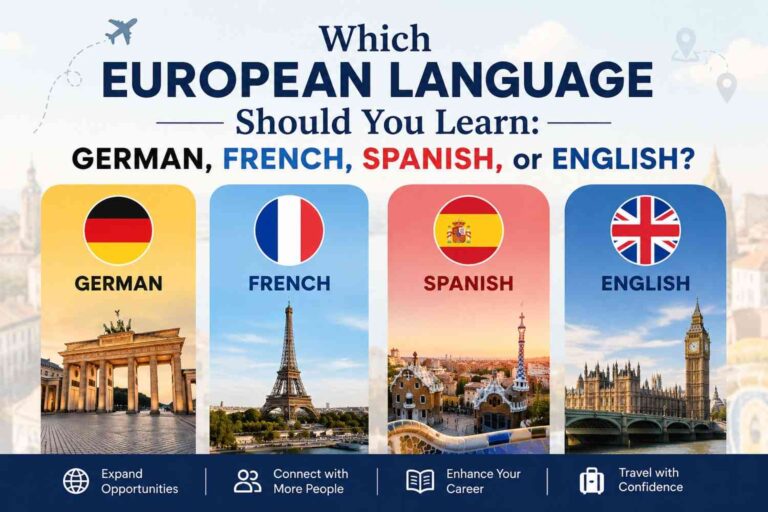
Why are so many people comparing German, French, Spanish, and English today?
Choosing a language affects your career, education, travel, and migration plans.
Each language offers unique advantages.
Your best choice depends on your goals.
Key comparison factors include:
- Career opportunities
- Global speakers
- Learning difficulty
- European mobility
- Higher education
- Business demand
- Immigration pathways
Understanding these factors makes choosing easier.
What Is the Difference Between German, French, Spanish, and English Languages?
- I compare German, French, Spanish, and English based on career value, global usage, learning difficulty, and practical benefits.
- German is a major European language with 75+ million native speakers. It is widely used in Germany, Austria, and Switzerland.
- French is an official language in many international organizations. It is spoken across Europe, Africa, and Canada.
- Spanish has 500+ million global speakers. It provides access to Spain, Latin America, and global Spanish-speaking communities.
- English is the most widely used international language. It remains the primary language for global business, technology, science, and education.
How Should I Choose Between German, French, Spanish, and English?
I select my language based on my personal goal.
Career in Germany or European industries → German
- I prioritize German if I want opportunities in engineering, technology, research, or manufacturing.
Travel and global communication → Spanish
- I choose Spanish for wider geographical reach.
International organizations and diplomacy → French
- I prefer French for global institutions and multicultural careers.
Global foundation language → English
- I choose English as the first language for worldwide communication.
Which European language is most useful for business?
- German is one of the strongest choices for business-focused learners in Europe.
- I choose German language when my goal is accessing engineering, technology, automotive, healthcare, and manufacturing industries.
- Germany has one of Europe’s largest economies. Many multinational companies use German for internal communication and business operations.
- Specialized bilingual professionals can experience an 11% to 15% wage premium compared to similar monolingual roles.
Why is German valuable for European careers?
I consider German useful because:
- Germany is a leading economic power in Europe.
- German-speaking countries offer opportunities in technology and research.
- German skills improve access to companies in Germany, Austria, and Switzerland.
- German proficiency supports study and employment opportunities.
Which language offers the best long-term career opportunities?
For technical careers:
- German For diplomacy
- French For international tourism
- Spanish For multinational companies
- English Career goals should determine your decision
Which language has the highest return on investment (ROI) for careers?
German often provides high career ROI for professionals targeting European markets.
I evaluate language ROI through:
- Job availability.
- Salary potential.
- Industry demand.
- Global usefulness.
Which language improves professional opportunities?
German benefits:
- Engineers.
- IT professionals.
- Healthcare workers.
- Researchers.
French benefits:
- International relations.
- Luxury industries.
- Tourism.
- Government careers.
Spanish benefits:
- Global business.
- Customer support.
- International sales.
English benefits:
- Technology.
- Finance.
- Academic research.
- Global communication.
Is English enough to live and work in Europe?
English helps me communicate internationally, but it is not always enough for long-term integration.
Many European countries use English for business environments. However, local language skills improve employment opportunities and daily communication.
Why should I learn another European language if I know English?
I learn another language because:
- Local employers value multilingual candidates.
- Daily life becomes easier.
- Cultural understanding improves.
- Career options expand.
English gives me access. Local languages help me build deeper connections.
Which language is best for studying in Europe?
- German leads for higher education.
- Germany offers many public universities with low or no tuition.
- German proficiency improves admission opportunities.
- French supports education in France and Belgium.
- Spanish benefits students choosing Spain.
- English supports international programs throughout Europe.
What are CEFR Levels A1 to C2, and why do employers care?
The Common European Framework of Reference (CEFR) measures language ability.
The levels include:
- A1 – Beginner
- A2 – Elementary
- B1 – Intermediate
- B2 – Upper Intermediate
- C1 – Advanced
- C2 – Near-native proficiency
Many German universities require B2.
Many employers accept B1 or B2.
If you need structured preparation for these levels, professional German Certification Courses provide guided learning from A1 through B2.
Before choosing German, understand the German Language Levels (A1 to C2) required for study and work.
Which language is best for immigration?
Your destination matters.
Choose German if you plan to live in:
- Germany
- Austria
- Switzerland
Choose French if moving to:
- France
- Quebec
- Belgium
Choose Spanish for:
- Spain
- Latin America
Choose English for:
- International careers
- Global relocation
Which language is easiest for English speakers?
- Learning speed depends on linguistic proximity.
- Spanish and French share many cognates with English.
- German also shares Germanic roots with English.
However, German grammar is more complex.
Estimated learning difficulty:
- Spanish: Easy
- French: Easy to Moderate
- German: Moderate
English speakers usually reach conversational Spanish first.
Is German harder to learn than French or Spanish?
German is generally considered more challenging than French and Spanish for English speakers.
The Foreign Service Institute (FSI) estimates:
Spanish and French require approximately 24 weeks or 600 classroom hours for professional working proficiency.
German requires approximately 36 weeks or 900 classroom hours.
I find German grammar more complex because of:
- Four grammatical cases.
- Three noun genders.
- Flexible sentence structures.
French and Spanish are usually easier for beginners because they share many vocabulary similarities with English.
Why does German take longer to learn?
I spend more time learning German because grammar rules require consistent practice.
I need to understand:
- Noun cases.
- Sentence positioning.
- Gender-based articles.
- Formal and informal communication styles.
How many people speak each language worldwide?
Approximate global speakers:
- English – Around 1.5 billion speakers
- Spanish – Around 600 million speakers
- French – Around 320 million speakers
- German – Around 135 million speakers
English has the widest international reach.
Spanish has strong growth across the Americas.
French continues expanding across Africa.
German dominates Europe’s largest economy.
What is the difference between Romance languages and Germanic languages?
Language families explain similarities.
Romance languages
Include:
- French
- Spanish
- Italian
- Portuguese
- Romanian
Characteristics:
- Latin origin
- Similar vocabulary
- Similar grammar patterns
- Many shared cognates
Germanic languages
Include:
- German
- English
- Dutch
- Swedish
- Norwegian
- Danish
Characteristics:
- Different sentence structure
- Strong compound word formation
- Shared historical roots
Understanding language families helps learners transfer vocabulary faster.
Should I learn Spanish or French for travel?
Spanish is the better choice if I want wider travel coverage.
I access more countries with Spanish because it has 500+ million global speakers across Spain, Mexico, Central America, and South America.
French is valuable for international travel because it is spoken in Europe, Africa, Canada, and parts of the Caribbean.
Which language helps more during international travel?
I choose Spanish for:
- Latin American travel.
- Cultural experiences.
- Connecting with large Spanish-speaking communities.
I choose French for:
- European destinations.
- African countries.
- International organizations.
Which language is best for travel across Europe?
- English remains the easiest travel language.
- German helps throughout Central Europe.
- French supports travel across Western Europe.
Spanish is valuable in Spain.
Travel usefulness:
- English: Excellent
- German: Very Good
- French: Very Good
- Spanish: Good
What are the biggest advantages and disadvantages of each language?
German
Pros
- High salaries
- Strong engineering demand
- Excellent education opportunities
- Europe’s largest economy
Cons
- More grammar rules
- Longer learning timeline
French
Pros
- International organizations
- Global cultural influence
- Widely spoken across Africa
Cons
- Pronunciation challenges
- Silent letters
Spanish
Pros
- Fast learning
- Large speaker base
- Excellent travel language
Cons
- Slightly fewer opportunities in Central Europe
English
Pros
- Global communication
- Business standard
- Huge online content
Cons
- Less differentiation in competitive job markets
Should you learn German before French or Spanish?
Choose German if your goals include:
- Studying in Germany
- Nursing careers
- Engineering
- Manufacturing
- Skilled migration
- Long-term European employment
Choose French if your focus is:
- International organizations
- Luxury brands
- Diplomacy
Choose Spanish if your priority is:
- Travel
- Latin American business
- Fast language acquisition
Choose English if you need:
- International communication
- Global employment
- Remote work
What Are the Key Factors Before Learning a European Language?
I consider these factors before starting:
- Career Goal: Choose the language connected to my industry.
- Location: Select the language spoken where I want to live.
- Learning Time: Consider FSI difficulty timelines.
- Interest: Choose a language that motivates regular practice.
Final Recommendation
- I choose a European language based on my future goals.
- I select German for European career growth and professional opportunities.
- I select Spanish for global reach and travel.
- I select French for international careers and cultural connections.
- I select English for worldwide communication and business access.
The best language is the one that matches my career plans, lifestyle goals, and long-term learning commitment.
- Every language creates valuable opportunities.
- English provides universal communication.
- Spanish offers the fastest learning curve.
- French excels in diplomacy and international relations.
- German delivers exceptional career value in Europe’s strongest economy.
If your goal includes Germany, engineering, healthcare, higher education, or long-term European employment, learning German is often the strongest investment.
A structured learning path from CEFR A1 to B2 with experienced instructors can significantly improve your progress.
Frequently Asked Questions About Choosing a European Language
Is German more valuable than Spanish for career growth?
- German can provide stronger opportunities for professionals targeting European industries. Spanish offers broader global communication because it has 500+ million speakers worldwide.
How long does it take to learn German compared to French?
- According to the Foreign Service Institute (FSI), German requires around 36 weeks or 900 classroom hours. French requires around 24 weeks or 600 classroom hours for English speakers.
Which European language should I learn for studying abroad?
- German is a strong option for students interested in German universities and European career opportunities. French and Spanish are also valuable depending on the destination country.
Can English speakers easily learn Spanish or French?
- English speakers often find Spanish and French easier because of shared vocabulary and simpler learning structures compared with German grammar.
Which language gives the highest salary advantage?
- Specialized bilingual professionals can receive an estimated 11% to 15% wage premium. The exact benefit depends on industry, location, and professional skills.