
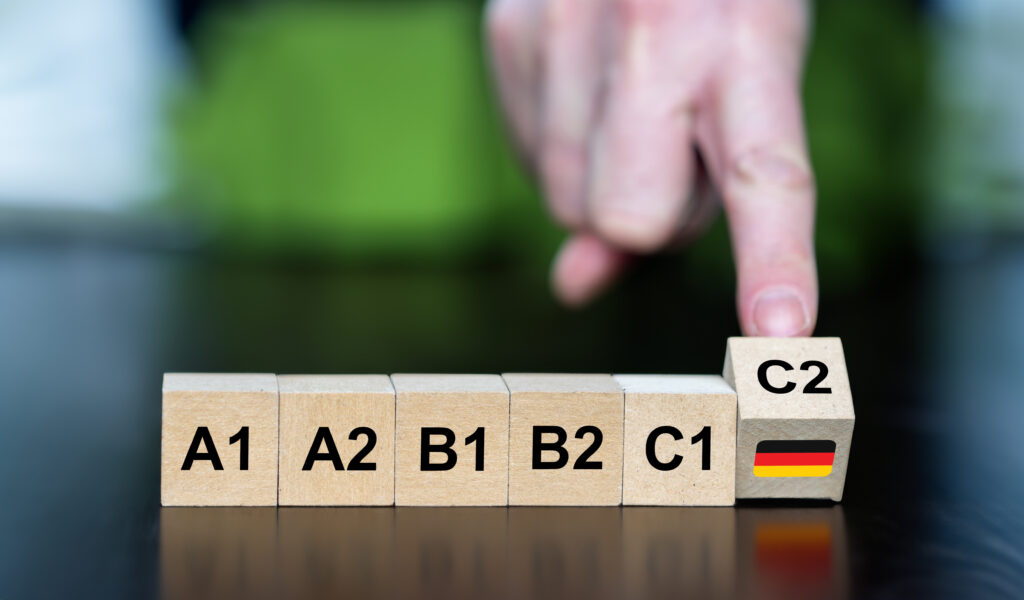
If you’ve ever searched for a German course and felt confused by the labels A1, A2, B1, B2, C1, and C2 you’re not alone. These are the official German language levels used worldwide to measure how well you understand, speak, read, and write German. They come from the Common European Framework of Reference for Languages or CEFR, and they apply to every learner from someone who just said their first “Hallo” to someone reading Goethe in the original.
Understanding these levels matters because every course, exam, visa requirement, and job listing in Germany refers to them. Before you invest time and money into learning, it helps to know exactly what each level means, what skills it builds, and how long it takes to get there.
What Is the CEFR and Why Does It Matter for German Learners?
The Common European Framework of Reference for Languages was developed by the Council of Europe to create a consistent, internationally recognized way to describe language ability. It organizes learning into six progressive stages A1, A2, B1, B2, C1, and C2 grouped under three broad categories:
- A (Basic User) — A1 and A2
- B (Independent User) — B1 and B2
- C (Proficient User) — C1 and C2
Every major German language examination including the Goethe-Zertifikat, TELC, TestDaF, and DSH is mapped directly to this framework. So whether you’re preparing for university admission, a work visa, or simply personal growth, your CEFR level is the universal currency of German learning.
A1 German Level Absolute Beginner
A1 is where every German learning journey begins. At this stage, the goal is simple: survive basic interactions in a German-speaking environment. You’re not expected to hold conversations, you’re learning to recognize the language, build foundational habits, and communicate your most essential needs.
Skills you develop at A1:
- Introduce yourself – your name, age, country, and profession
- Greet people and say goodbye using appropriate expressions for different times of day
- Count, use basic numbers, tell the time, and name the days of the week
- Name common everyday objects, colors, and family relationships
- Order food and drinks, ask for the bill, and make simple purchases
- Fill in basic forms with personal information
Vocabulary range: Around 500 to 800 words enough for essential, predictable interactions.
Real-life example: You walk into a German supermarket, find what you need, ask where the dairy section is (“Wo ist die Milch, bitte?”), and pay at the checkout, all without panic.
At A1, you study the German alphabet and pronunciation rules, learn the present tense, start understanding noun genders (der, die, das), and build your first vocabulary bank through repetition and listening.
A2 German Level — Elementary
Once you complete your German A1 course and move into A2, the training wheels come off slightly. You’re no longer just surviving; you’re beginning to communicate. A2 learners can talk about their daily lives, describe familiar environments, and handle most routine tasks without needing someone to slow down dramatically for them.
Skills you develop at A2:
- Talk about your daily routine, work, hobbies, and family
- Describe past events using the Perfekt tense
- Read and understand short texts – notices, menus, simple emails, and schedules
- Make and respond to invitations, suggestions, and arrangements
- Ask for and give directions in a city or building
- Express opinions on simple, familiar topics
Vocabulary range: Approximately 1,000 to 1,500 words.
Real-life example: You call a doctor’s office in Germany, explain that you have a sore throat and a fever, and successfully book an appointment for the following morning, understanding most of what the receptionist says in reply.
The A2 German course introduces modal verbs (können, müssen, wollen, dürfen), separable verbs, the accusative and dative cases, and basic prepositions. Speaking practice becomes critical here, because A2 is when learners start building real conversational reflexes.
Learners based in South India often start with an online German speaking course in Hyderabad to build spoken confidence before tackling grammar-heavy A2 material, a smart approach, since speaking practice early on reduces hesitation later.
B1 German Level – Intermediate
B1 is the first major milestone in German learning and for many learners, the most transformative stage. This is where German stops feeling like a translation exercise and starts functioning as an actual communication tool. At B1, you can handle most situations that come up while living or traveling in a German-speaking country, and you can express your thoughts on familiar topics without constant struggle.
Skills you develop at B1:
- Hold extended conversations on topics like work, education, travel, and current events
- Understand the main points of a German podcast, radio program, or news article on familiar subjects
- Write structured texts – emails, short essays, complaints, and personal messages
- Describe experiences, ambitions, and events in both present and past time frames
- Navigate unexpected situations – a delayed train, a problem at your accommodation, a misunderstanding at work
- Share opinions and explain your reasoning, even if imperfectly
Vocabulary range: Around 2,000 to 2,500 words.
Real-life example: You attend a team meeting at your Berlin office, follow most of the discussion, contribute your perspective when asked, and send a follow-up email in German summarizing what was agreed not flawlessly, but effectively.
The B1 German language course covers the Konjunktiv II mood, passive voice, relative clauses, and complex sentence structures. It also prepares learners for the Goethe-Zertifikat B1 one of the most widely accepted German certificates for visa and immigration purposes.
B2 German Level – Upper Intermediate
B2 is arguably the most practically important German level for anyone planning to study, work, or settle in Germany. At this stage, you can communicate fluently and spontaneously with native speakers, understand complex texts on a wide range of topics, and handle demanding professional or academic situations without major difficulty.
Skills you develop at B2:
- Understand the main ideas of complex texts – including abstract, technical, and professional content
- Watch German TV shows, films, and documentaries without relying on subtitles most of the time
- Interact fluently with native speakers without either side straining to communicate
- Write clear, well-structured texts on complex subjects – reports, essays, and professional correspondence
- Debate issues, defend your point of view, and acknowledge opposing arguments
- Pick up nuance, humor, and implied meaning in spoken and written German
Vocabulary range: Around 4,000 to 5,000 words.
Real-life example: You watch a German documentary about climate policy, follow the debate between scientists and politicians, form your own opinion, and discuss it confidently with a German colleague over lunch – without mentally translating every sentence.
An A2 German course might feel like a big jump away, but the journey to B2 is linear and achievable with consistent effort. Learners in metropolitan areas who want flexible, intensive options often turn to learn German language online in Bangalore programs that allow them to move through B1 and B2 at an accelerated pace without sacrificing depth.
The B2 German course focuses on advanced grammar, reading comprehension of authentic texts, academic writing, and professional vocabulary. It also prepares learners for the TestDaF and DSH – the two most widely accepted language certificates for German university admission.
C1 German Level Advanced
At C1, German becomes a genuine professional and academic instrument. You no longer think about grammar rules consciously. You can navigate any social, academic, or professional situation in German with fluency, precision, and flexibility. C1 speakers are not just communicating; they are persuading, arguing, negotiating, and expressing subtle shades of meaning.
Skills you develop at C1:
- Express yourself spontaneously and fluently without obvious effort or searching for words
- Understand long, demanding texts including academic papers, literary works, and specialized reports
- Produce clear, well-structured, and detailed text on complex subjects
- Recognize implicit meaning, cultural references, and professional register shifts
- Participate in German seminars, conferences, and business negotiations with confidence
- Adapt your language style formal, informal, technical, or persuasive depending on context
Vocabulary range: Around 8,000 to 10,000 words.
Real-life example: You negotiate a business partnership with a German manufacturing company, draft the summary agreement in German afterward, then explain the key terms to your Indian team all in the same day.
The C1 German course focuses on academic writing style, idiomatic expression, advanced reading comprehension, stylistic precision, and professional communication strategies. Learners preparing for the Goethe-Zertifikat C1, a widely respected credential for employment in Germany typically study at this level for six to twelve months after reaching solid B2.
C2 German Level Proficient (Mastery)
C2 is the summit of the CEFR scale, the point at which your German is functionally equivalent to that of an educated native speaker. You can understand virtually everything you encounter in German, express yourself with exceptional precision and nuance, and handle any linguistic challenge from legal contracts to literary analysis with ease and sophistication.
Skills you develop at C2:
- Understand any form of German written, spoken, dialectal, or highly technical with complete ease
- Synthesize and summarize information from multiple complex sources
- Express yourself with fine-grained precision, adapting tone, style, and register effortlessly
- Read classical German literature, legal documents, and academic journals without difficulty
- Deliver speeches, presentations, and lectures in German at a native or near-native standard
- Distinguish subtle shades of meaning between near-synonyms and stylistic registers
Vocabulary range: 16,000 or more words comparable to an educated German native speaker.
Real-life example: You read The Trial by Franz Kafka in the original German, write a literary essay analyzing its themes, then deliver that essay as a lecture at a university seminar in Frankfurt.
The C2 German level is generally reached through years of immersive real-world use, advanced academic study, and deep engagement with German culture and media. Formal C2 German courses exist primarily for certification the Goethe-Zertifikat C2 (Großes Deutsches Sprachdiplom) is the most prestigious and internationally recognized C2 credential available.
Which German Level Do You Actually Need?
For Studying in Germany
Most German public universities require a minimum of B2 German to enroll in German-taught programs. Specifically:
- B1–B2 is required for most language preparatory courses (Studienkolleg)
- B2 is the minimum for undergraduate admission (demonstrated through TestDaF or DSH)
- C1 is expected for competitive master’s programs, research positions, and academic seminars
- C2 is ideal for doctoral study, academic writing, and university teaching roles
For Working in Germany
Language requirements for employment vary significantly by sector:
- A2–B1 is sufficient for unskilled manual or trade roles
- B2 is legally required for healthcare professionals such as nurses and care workers in most German federal states
- B2–C1 is expected for engineering, finance, and technical roles
- C1 is typically required for management, law, teaching, and any client-facing professional position
- C1–C2 is standard for academic research, journalism, and roles that involve producing German-language content professionally
For PR, Visa, and German Citizenship
- A1 is the minimum for a German spouse/family reunion visa
- B1 is required for permanent residence (Niederlassungserlaubnis) and the EU Blue Card pathway
- B1 is the minimum for German citizenship (Einbürgerung), though B2 is increasingly recommended for a stronger application
- Always verify current requirements with the relevant German consulate or Ausländerbehörde, as rules can vary by state and visa category
How Long Does It Take to Reach Each German Level?
The time it takes to progress through the German language levels depends on your study consistency, prior language experience, and learning method. Here are general benchmarks for dedicated learners:
- A1: 4 weeks
- A2: 4 to 8 weeks (Average course duration)
- B1: 4 to 8 weeks (Average course duration)
- B2: 8 weeks (Average course duration)
- C1: 8 weeks (Average course duration)
- C2: 8 weeks (Average course duration)
These are cumulative estimates for structured learning. Immersive environments living in Germany, working with native speakers daily, or taking intensive full-time courses can accelerate progression significantly.
Learners in coastal cities who prefer flexible, self-paced schedules often explore online German course in Mumbai options that let them study in shorter daily sessions across a longer timeline a model that works especially well for B1 and B2, where comprehension depth matters more than speed.
Conclusion: Your German Level Is Your Roadmap
The German language levels A1 through C2 are not just administrative labels. They are a clear, structured roadmap that tells you exactly where you are, what you’re working toward, and how far you’ve come. Each level has a concrete skill set, a realistic timeframe, and a real-world value whether you’re chasing a university seat in Munich, a nursing job in Hamburg, or simply the satisfaction of holding a real conversation in one of Europe’s most important languages.
Start with clarity. Know your current level. Choose a course aligned with your goal. And keep moving because every level you complete in German is a door that opens somewhere meaningful.
Ready to take the next step?
Enroll in the best German language course today from a complete beginner’s German A1 course to an intensive C1 German course for professional certification. Find the right program for your level, your city, and your ambitions and start building something real.
FAQ: About German Language Levels
1. What is A1 level in German?
- A1 is the beginner level of German. At A1, you can use simple phrases, introduce yourself, answer basic questions about your name, age, and where you’re from, and interact in a limited way with others who speak slowly and clearly. It takes roughly 60 to 80 hours of study to reach A1 from zero.
2. Is B2 German enough for Germany?
- Yes. B2 German is sufficient for most practical purposes including university admission, most professional jobs, and the permanent residence permit. For competitive academic programs or senior professional roles, C1 gives you a stronger advantage. But B2 is a well-respected benchmark that opens most major doors in Germany.
3. How long does it take to go from A1 to C1 in German?
- For an English speaker starting from zero, reaching C1 German typically requires 8 weeks (Average course duration) hours of structured study roughly two to three years of consistent effort with regular speaking practice. Intensive programs in Germany or full-time study can compress this timeline considerably.
4. Which German level is considered fluent?
- B2 is often described as conversational fluency you can handle most real-life situations effectively. C1 represents true professional fluency, where you communicate effortlessly on complex topics in any context. C2 is native-equivalent mastery.
5. Can I get a job in Germany with B1 German?
- B1 is sufficient for some manual, hospitality, or support roles. However, most professional positions especially in healthcare, engineering, education, and corporate environments require B2 or C1. The higher your level, the wider your career options in Germany.
6. Which German certificate is best for a visa?
- The Goethe-Zertifikat A1 is accepted for family reunion visas. The Goethe-Zertifikat B1 and TELC B1 are accepted for permanent residence applications. For university admission, the TestDaF (TDN 4) or DSH-2 are the standard choices.
7. Is online German learning as effective as classroom learning?
- For structured levels like A1 through B2, well-designed online German courses are highly effective especially when they include live speaking sessions, interactive exercises, and feedback from qualified teachers. Learners preparing for exams often supplement online study with mock tests and conversation practice. Those in South India preparing for spoken fluency sometimes start with an online classes for German in Chennai to build a speaking habit before tackling written grammar in depth.